
+917838994961

Currently it only shows your basic business info. Start adding relevant business details such as description, images and products or services to gain your customers attention by using Boost 360 android app / iOS App / web portal.

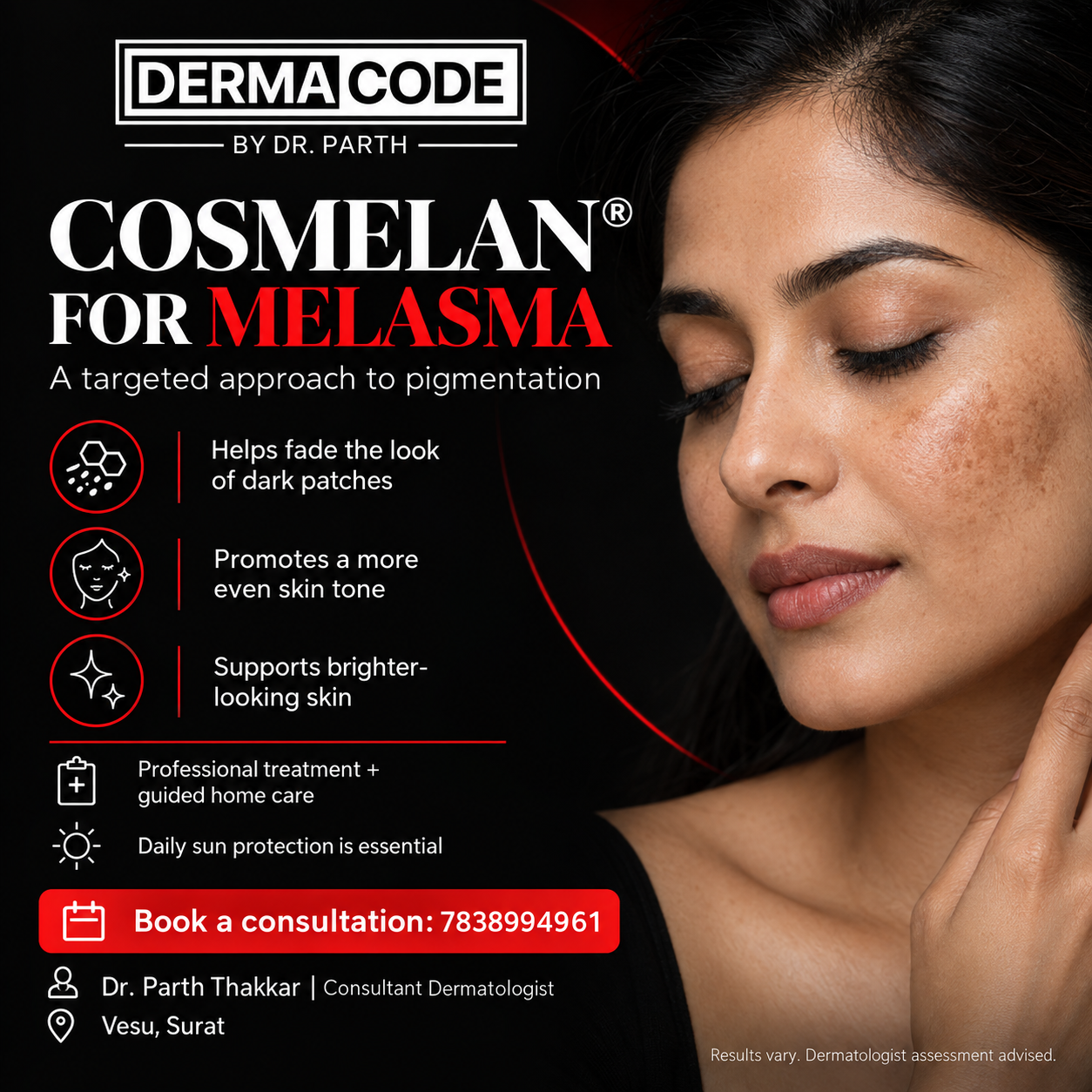
Targeted Melanogenesis Suppression: The Transformative Benefits of Cosmelan Peel for Melasma at Dermacode by Dr. Parth Melasma represents one of the most therapeutically stubborn, recurrent, and psychologically distressing pigmentary dermatoses encountered in modern clinical practice, particularly among individuals with Fitzpatrick Skin Types III to V characteristic of Indian complexions. Clinically manifesting as symmetrical, reticulated macules and patches of brown, grayish-brown, or slate-colored hyperpigmentation across sun-exposed facial zones—most prominently the malar cheeks, forehead, nasal bridge, upper cutaneous lip, and chin—melasma is driven by a complex interplay of genetic predisposition, ultraviolet and high-energy visible (HEV) blue light radiation, hormonal fluctuations (such as pregnancy, oral contraceptive use, or thyroid dysfunction), and chronic low-grade vascular inflammation. At the biological level, dermal and epidermal melanocytes in melasma-prone skin become chronically hyperactive and biologically unstable, producing excessive quantities of dark eumelanin and constantly shuttling pigment-laden melanosomes to adjacent keratinocytes. Because conventional superficial chemical peels (such as glycolic or salicylic acid) and high-energy thermal lasers can easily trigger post-inflammatory hyperpigmentation (PIH) or induce paradoxical rebound hyperpigmentation in melanin-rich Indian skin by overheating fragile melanocytes, managing severe melasma demands a controlled, non-thermal, enzymatically targeted medical depigmentation protocol: the world-renowned Cosmelan Depigmentation Peel. At Dermacode by Dr. Parth, located in Vesu, Surat at Solaris Kode, the Cosmelan Depigmentation Peel is delivered as an intensive, physician-supervised, two-phase medical depigmentation program engineered to eradicate existing epidermal pigment while systematically shutting down the enzymatic machinery that synthesizes new melanin. Directed personally by Dr. Parth Thakkar (MD Dermatology)—a board-certified dermatologist, dermatosurgeon, and aesthetic specialist with an extensive clinical career spanning premier institutions such as Kiran Hospital, Kaya Skin Clinic, Sakhiya Clinic, and VLCC—the Cosmelan protocol at Dermacode is calibrated to treat all clinical subtypes of melasma, including superficial epidermal, deep dermal, and recalcitrant mixed melasma. Unlike standard salon facials or mild clinic peels that merely induce a transient superficial exfoliation, Cosmelan works via a dual-action corrective and regulatory mechanism: it systematically sheds the heavily pigmented superficial stratum corneum, while concurrently delivering high concentrations of potent tyrosinase inhibitors deep into the basal epidermal layer, holding melanocytes in a sustained state of biological quiescence. The primary therapeutic benefit of the Cosmelan Peel lies in its ability to inhibit tyrosinase, the master copper-containing enzyme that catalyzes the initial, rate-limiting steps of melanogenesis—specifically the oxidation of L-tyrosine to L-DOPA and dopaquinone. The proprietary Cosmelan formulation combines a synergistic matrix of active depigmenting agents, including azelaic acid, kojic acid, phytic acid, arbutin, ascorbic acid (Vitamin C), and retinyl palmitate. When applied as a thick, specialized, clay-like topical mask (Cosmelan 1) in the sterile clinical environment at Dermacode, these active ingredients diffuse deeply through the cutaneous layers over a prescribed leave-on period of eight to twelve hours, tailored strictly to the patient's individual skin phototype, barrier tolerance, and melasma severity. Inside the skin, this multi-targeted formulation blocks tyrosinase activation, inhibits the maturation and transfer of melanosomes to keratinocytes, neutralizes oxidative free radicals that provoke pigment flares, and accelerates the gentle, non-aggressive desquamation of existing pigmented corneocytes. Over the following seven to fourteen days, the skin undergoes a controlled shedding process that removes the stubborn, surface-level brown mask, revealing a dramatically cleared, even-toned, and luminous complexion underneath. Beyond rapid surface clearing, the crucial clinical value of undergoing the Cosmelan protocol at Dermacode by Dr. Parth is its long-term regulatory phase (Cosmelan 2 homecare), which prevents the frustrating rebound hyperpigmentation that plagues almost all other melasma therapies. Melasma is a chronic dermatological condition; the underlying melanocytes retain an intrinsic memory of hyperactivity, meaning that as soon as a superficial peel or laser treatment finishes, the slightest UV exposure can trigger immediate pigment relapse. The Cosmelan method solves this chronic challenge by pairing the in-clinic intensive mask with a structured, multi-month homecare regimen containing micro-dosed tyrosinase suppressors and barrier-repair lipids. Under Dr. Parth’s continuous dermatological monitoring, patients follow a disciplined daily maintenance routine that keeps melanocyte hyperactivity suppressed month after month, progressively fading deep dermal pigment deposits, refining enlarged pores, smoothing coarse cutaneous micro-relief, and promoting robust neo-collagenesis that leaves the facial skin visibly firmer, healthier, and uniformly balanced. What makes Dermacode by Dr. Parth the premier destination for Cosmelan treatment in Surat is Dr. Parth Thakkar’s rigorous medical approach, diagnostic discipline, and individualized patient preparation. Recognizing that Indian skin can react with extreme sensitivity if an intensive peel is applied over an unstable or inflamed cutaneous barrier, Dr. Parth avoids the unsafe, off-the-shelf application seen in unregulated cosmetic lounges. Every patient journey at Dermacode begins with high-resolution digital dermoscopy and Wood's lamp examination to map out the exact depth, distribution, and vascularity of the melasma pigment, as well as assess baseline epidermal barrier function. For patients presenting with barrier compromise, sensitive skin, or active rosacea-like vascular components, Dr. Parth prescribes a specialized pre-peel barrier conditioning and pigment-priming routine for two to three weeks prior to applying the Cosmelan 1 mask. This meticulous pre-conditioning minimizes procedural erythema, prevents unwanted post-peel complications, and prepares the basal layer to accept the depigmentation actives uniformly. Furthermore, patient safety, comfort, and comprehensive follow-up care are held to hospital-grade standards at Dermacode’s state-of-the-art facility at Solaris Kode, Vesu. Recognizing that the intensive peeling phase requires active clinical reassurance and guidance, Dr. Parth and his specialized clinical team maintain close touchpoint evaluations at days three, seven, fourteen, and thirty to monitor re-epithelialization, adjust home maintenance application frequencies, and manage expected post-peel dryness with medical-grade soothing emollients and non-comedogenic broad-spectrum sunscreens. When appropriate, Dr. Parth harmonizes the depigmentation program with systemic antioxidant support, such as IV Glutathione drips or specialized oral photoprotective polypodium leucotomos supplements, creating a 360-degree defense against internal and external pigment triggers. Patients from Vesu, Althan, Adajan, City Light, and Varachha, as well as those traveling from neighboring industrial centers across South Gujarat, trust Dermacode by Dr. Parth to clear chronic melasma, restore skin barrier integrity, and deliver clear, radiant, and enduring aesthetic confidence.


