
+917838994961

Currently it only shows your basic business info. Start adding relevant business details such as description, images and products or services to gain your customers attention by using Boost 360 android app / iOS App / web portal.

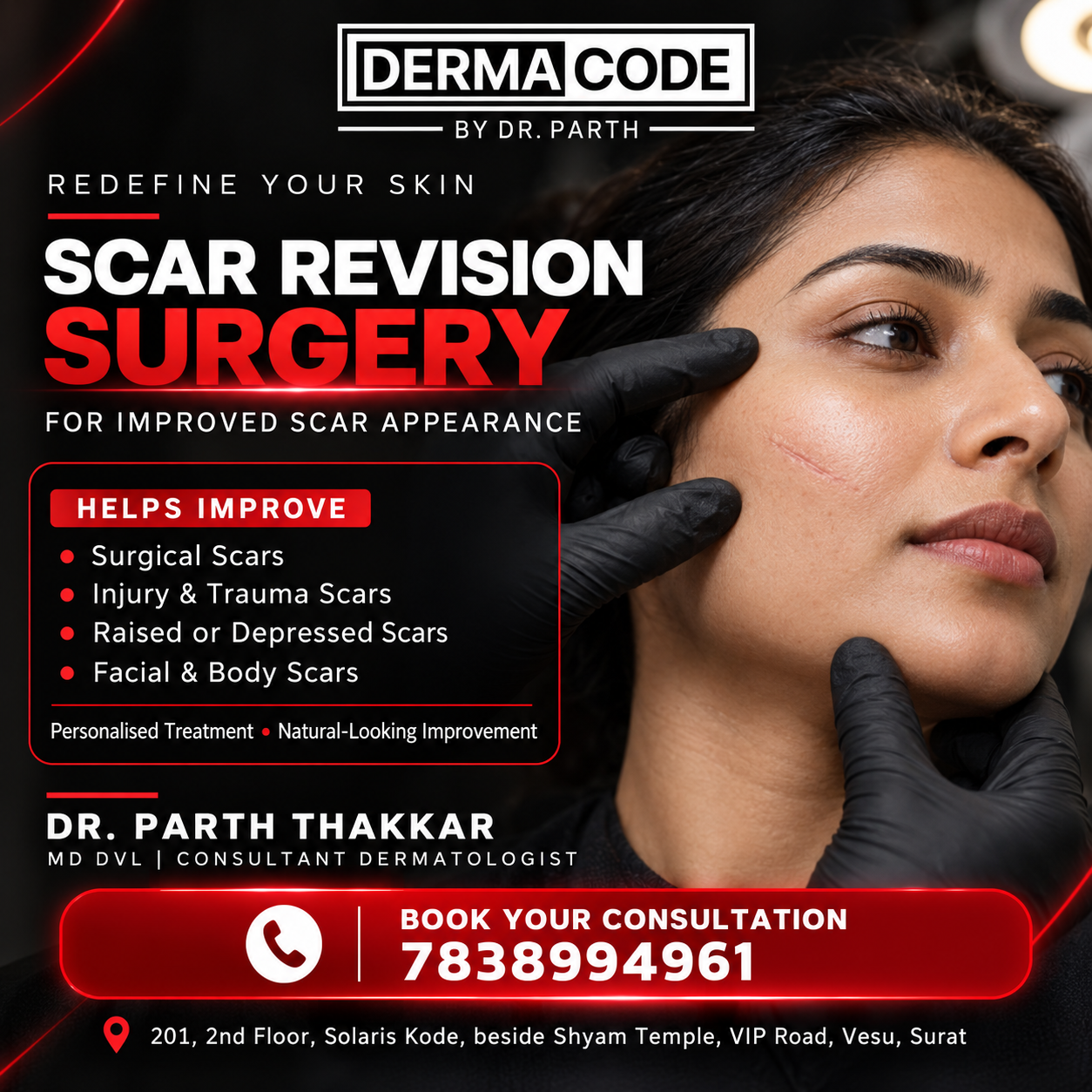
Advanced Multimodal Scar Revision and Why Dermacode by Dr. Parth is Surat's Leading Centre of ExcellenceCutaneous scarring—whether arising from severe cystic acne, surgical interventions, accidental physical trauma, or burns—represents an enduring architectural disruption of the dermis that deeply affects both skin health and individual self-esteem. When tissue sustains deep trauma extending past the papillary dermis into the reticular layer, the biological wound-healing cascade rushes to close the breach; however, instead of regenerating the intricate, basket-weave orientation characteristic of healthy Type I collagen and functional elastin, the body lays down dense, parallel, disorganized fibrotic bundles. This abnormal repair response produces a spectrum of disfiguring scar morphologies: atrophic scars (such as deep, narrow icepick scars, sharply demarcated boxcar depressions, and broad, undulating rolling scars that are tethered to the underlying subcutaneous fascia by dense fibrous bands) where dermal tissue has collapsed; and hypertrophic scars or keloids, where exaggerated fibroblast activity and dysregulated transforming growth factor-beta (TGF-β) signaling drive an overproduction of thick, rigid collagen that rises above the surrounding skin surface. Because human scars are rarely homogeneous—often presenting as a complex, three-dimensional mosaic of depth variations, fibrotic anchoring, pigmentary alterations (post-inflammatory hyperpigmentation or hypo-pigmented avascular zones), and irregular micro-relief—single-modality treatments like superficial chemical peels or generic microneedling fail to provide meaningful clinical improvement, necessitating advanced, multi-layered scar revision protocols that dismantle fibrotic tissue and rebuild the dermal architecture from within.Modern clinical scar revision operates by mechanically releasing deep fibrous adhesions, vaporizing rigid scar borders, and stimulating controlled dermal remodeling to replace pathologically scarred tissue with fresh, organized, physiological collagen. For bound-down rolling and deep boxcar scars, the essential first maneuver is blunt surgical subcision: by introducing specialized tri-beveled or Nokor-type cannulas horizontally into the subdermal plane beneath the scar, the physician mechanically severs the dense fibrous tethers pulling the epidermis downward toward the fascia, immediately releasing skin tension, lifting the sunken floor of the scar, and creating a healing pocket primed for cellular regeneration. To address vertical wall margins and surface irregularities, ablative Fractional Carbon Dioxide ($CO_2$, 10, 600 nm) laser resurfacing delivers micro-columns of high-energy thermal injury that vaporize fibrotic scar edges and trigger thermal shock proteins, while Microneedling Radiofrequency (MNRF) bypasses the melanin-rich epidermis to deliver insulated electrothermal energy directly into the deep reticular dermis, inducing robust neo-collagenesis and tightening surrounding skin without inducing surface burns. To accelerate healing, fill residual dermal deficits, and prevent the re-tethering of severed scar tissue, advanced regenerative adjuvants such as Polynucleotides (PDRN / Salmon DNA), Growth Factor Concentrate (GFC), Exosome signaling vesicles, or soft cross-linked Hyaluronic Acid dermal fillers are placed into the treated dermal planes, supplying extracellular matrix scaffolds and cellular signals that drive genuine tissue regeneration, normalize epidermal pigmentation, and smooth the overall contour of the skin.Achieving superior, predictable, and life-changing scar revision requires an experienced medical specialist who possesses advanced dermatosurgical skills, deep laser physics mastery, and a nuanced understanding of post-inflammatory hyperpigmentation (PIH) risks in Fitzpatrick Skin Types III to V—qualities that establish Dermacode by Dr. Parth, situated at Solaris Kode in Vesu, Surat, as the definitive destination for comprehensive scar revision across South Gujarat. Directed personally by Dr. Parth Thakkar (MD Dermatology), a board-certified dermatologist, dermatosurgeon, and aesthetic specialist who has honed his clinical craft across renowned institutions including Kiran Hospital, Kaya Skin Clinic, Sakhiya Clinic, and VLCC, Dermacode firmly rejects the standardized, machine-only packages offered by commercial cosmetic chains. Dr. Parth treats scar revision not as a generic procedure, but as a specialized reconstructive art that begins with meticulous diagnostic mapping: utilizing oblique lighting, cross-polarization, and high-resolution digital dermoscopy, he maps each scar on the patient's face or body, categorizing individual lesions by depth, tethering severity, and histological morphology. Recognizing that no single technology can resolve a multi-faceted scar condition, Dr. Parth creates customized, phased multi-modality roadmaps—seamlessly combining targeted TCA Cross (Chemical Reconstruction of Skin Scars) for narrow icepick pits, cannula subcision for tethered rolling depressions, Fractional $CO_2$ Laser or MNRF for texture blending, and regenerative exosome infusions to cut recovery downtime in half—tailoring every pulse, depth, and energy parameter directly to the patient’s individual healing response.At Dermacode, procedural safety, sterile surgical discipline, and state-of-the-art medical technology are maintained at hospital-grade standards, ensuring patients receive the safest and most advanced scar revision care available in Surat. Unlike aesthetic salons where high-energy lasers and surgical subcision are delegated to non-medical staff, every critical stage—from deep tissue tether release to fractional laser calibration—is executed directly by Dr. Parth Thakkar in sterile procedure rooms designed to ensure absolute infection control. Furthermore, because Indian skin phototypes are particularly vulnerable to thermal hyperpigmentation, Dr. Parth implements strict pre-procedural pigment-priming regimens and post-procedure barrier-repair protocols, ensuring that aggressive scar remodeling occurs safely without leaving behind post-inflammatory dark marks or surface damage. Supported by structured follow-up evaluations that track multi-month collagen maturation and gradual textural refinement, patients traveling from Vesu, Althan, Adajan, City Light, and Varachha, as well as outstation clients from across South Gujarat, Maharashtra, and Madhya Pradesh, trust Dermacode by Dr. Parth to restore smooth skin texture, erase long-standing scars, and deliver lasting aesthetic confidence.


